
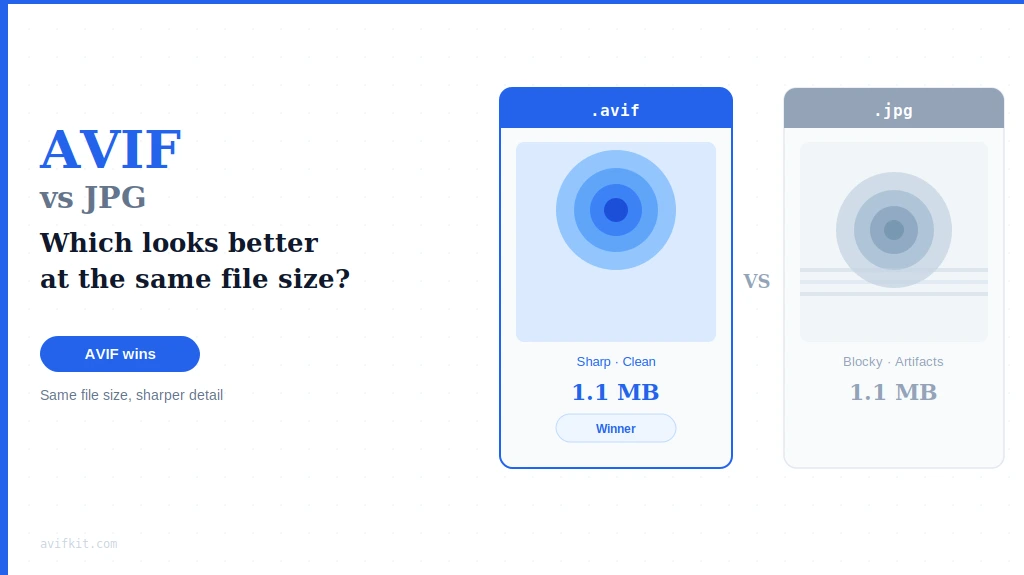
Same sunset photo. Same 100KB target. Two formats. I pulled both up on a 4K monitor and looked. The gap was bigger than I thought it'd be.
The Test: Same Photo, Same File Size, Different Formats
I didn't want to read another benchmark chart. I wanted to actually see it. So I kept it simple:
- Source: 24MP landscape photo, 6000×4000px
- Target: exactly 100KB in both formats
- Quality dialed until each hit 100KB
- Compared at 100% zoom on a calibrated display
What I Found: AVIF Wins — With One Caveat
At 100KB, AVIF held onto a lot more detail. The JPG had that familiar chunky sky, banding in the gradients, mosquito noise around sharp edges. The usual.
AVIF looked clean. The compression was still there if you zoomed in hard enough, but it fell apart gently — no blocks, no banding.
The catch:
Tried to open the AVIF on my older laptop — Windows 10, no codec extensions installed. Nothing. Windows Photos threw an error. The JPG? Opened everywhere without a second thought. Old phone, work PC, my parents' ancient desktop.
When AVIF Makes Sense
Go with AVIF if:
- You're serving images on a modern site (detect support, serve fallbacks)
- You control the viewing environment — internal tools, apps
- Bandwidth matters more than compatibility
- You're archiving images for the future (AVIF support will only grow)
When JPG Still Wins
Stick with JPG if:
- You're sharing with non-technical people
- Files need to open on multiple devices without any setup
- You're working with older software like Photoshop CS6
- You're emailing images — AVIF support in email clients is still patchy
- You just want something that works, every time, no surprises
The Practical Fix: Convert When You Need To
When someone sends me an AVIF I can't open, I just convert it. Two seconds with AvifKit. No install, no account, runs in the browser.
Sure, some quality gets left behind. But for casual viewing, social media, or printing at normal sizes? You won't notice.
Frequently Asked Questions
Is AVIF always smaller than JPG?
At the same visual quality, yes — typically 30–50% smaller. Crank up JPG compression and you can match file sizes, but the image quality won't hold up.
Why doesn't everyone just use AVIF then?
Compatibility. AVIF only works in modern browsers and apps. JPG works everywhere — old phones, email clients, legacy software, your local print shop. For most people, that still matters more than better compression.
Will converting AVIF to JPG shrink the file?
Usually the opposite — AVIF is already leaner. Converting to JPG tends to produce a larger file, unless you apply heavy compression (which hurts quality).
Can I convert JPG to AVIF to save space?
You can, but it's mostly pointless. JPG is already lossy. Converting lossy-to-lossy just stacks up more degradation. AVIF really shines when you start from a lossless source — PNG, TIFF, RAW.
Bottom Line
AVIF compresses better. JPG opens everywhere. For now: convert AVIF to JPG when it needs to just work. Use AVIF when you own the environment and file size is what you're optimizing for.
Got an AVIF that won't open?
Convert to JPG in seconds. Works on any device, in any app.
Convert AVIF to JPG